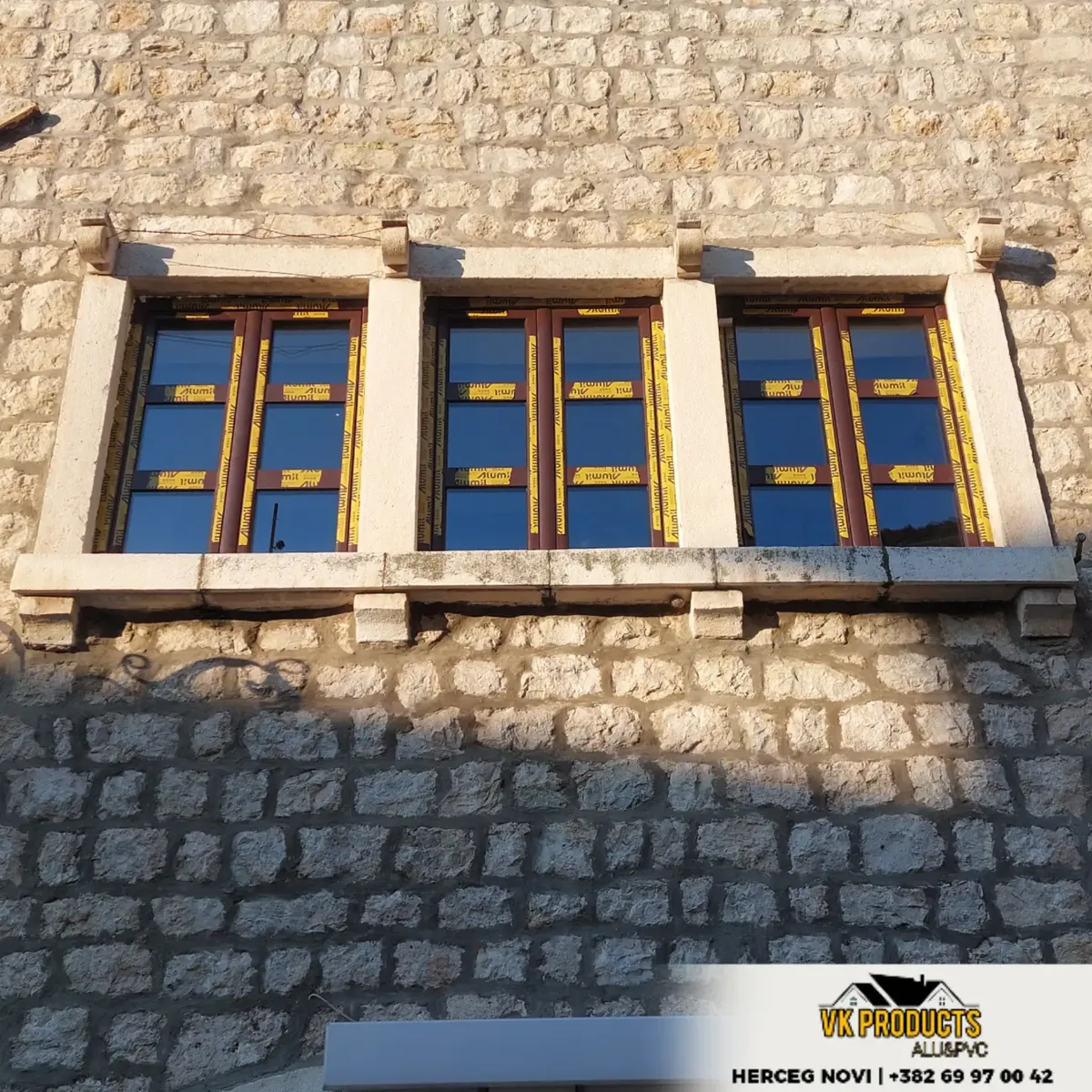
Hardly anyone asks about drip sills until stains appear on the façade below the window. And by then it's too late.
If you've never renovated a flat or replaced windows, you may never have heard of a drip sill, okapnica in Montenegrin. Yet it's one of the most important details on a house.
What it does
A drip sill is the metal sill under the window on the outside. Its job is to carry rainwater running down the glass and frame away from the wall. Without it, water runs straight down the façade, leaves dark streaks, soaks the wall and, worst of all, gets into the joint between wall and window. You see the result indoors: damp on the reveal and mould under the window.
On the coast this matters even more. The jugo wind drives rain almost horizontally, so windows on the exposed side take far more water than inland.
Aluminium or PVC?
Drip sills can be aluminium or PVC, but we fit aluminium ones. They last longer, protect the wall better and don't warp in the sun. The sheet can be galvanised or powder-coated; we prefer powder-coated because it's made to measure, bent to the shape of the opening and finished in the colour of the windows or façade.
What a properly fitted drip sill looks like
- It slopes outwards: water must never sit on it.
- It projects beyond the façade by a few centimetres, with a turned-down edge so water drips off rather than running down the wall.
- It has end caps: without them water escapes at the ends and wets the wall anyway.
- It's properly sealed under the window: so water can't get between the frame and the sill.
When to replace it
If an old sill is too short, has no slope, has rusted or water has already marked the façade, replacement is cheap compared with repairing the wall. It's simplest to do it with new windows, but we also fit drip sills on their own.