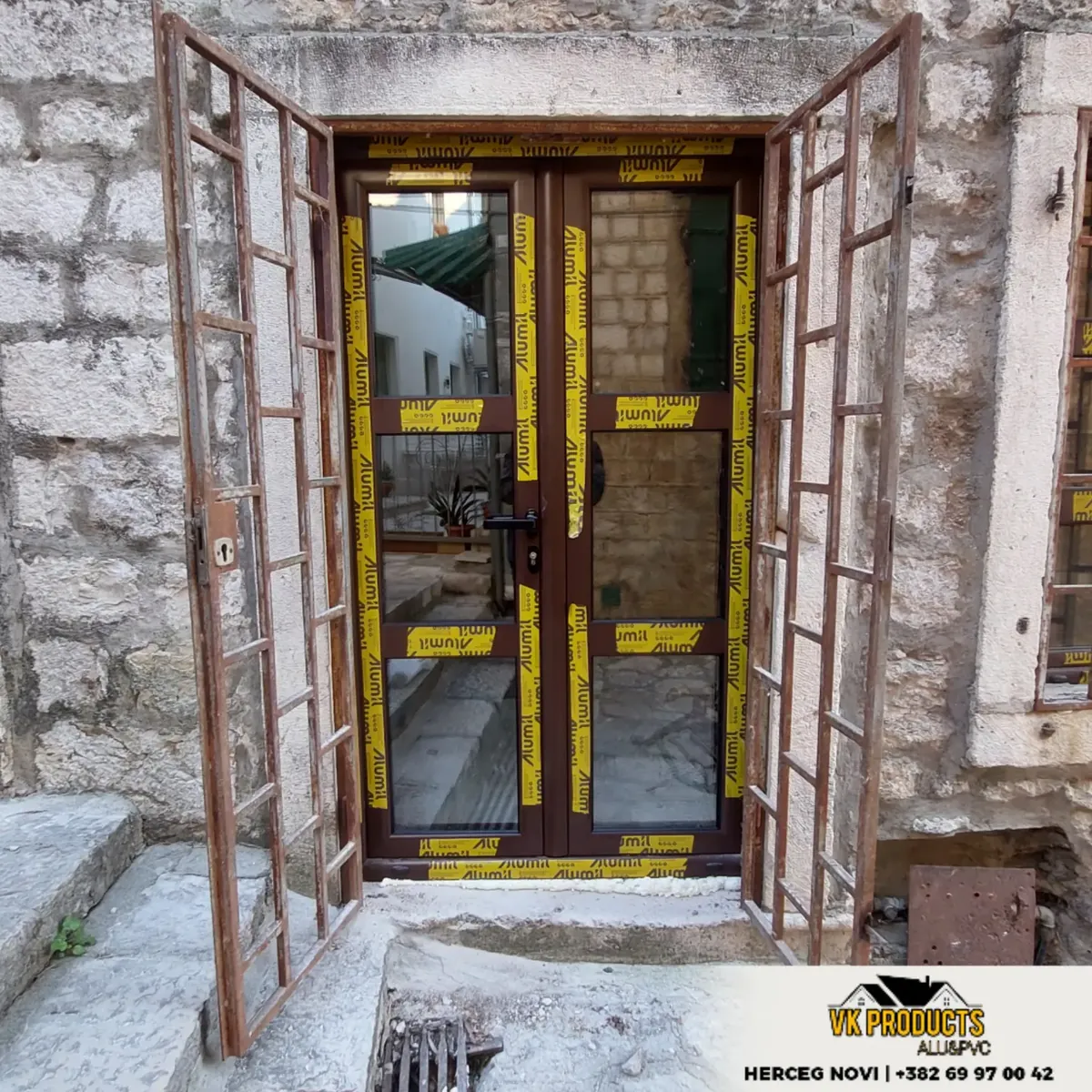
A door's security doesn't depend on the material alone. Here's what really makes the difference, and when it makes sense to pay more for aluminium.
When choosing a front door, people most often ask which material is more secure. Honest answer: both can be very secure, and both can be poor. Security comes from the hardware; the material decides the rest, looks, size, durability and price.
PVC entrance doors
They're more affordable, insulate well and come in many designs and colours. For a flat, a building entrance or a house with a standard opening, they're often all you need. With steel reinforcement in the profile and a good lock, they're harder to force than a typical wooden door.
PVC's limits are large sizes and dark colours in strong sun. Very wide or tall leaves, especially in anthracite on the south side, are better made in aluminium.
Aluminium entrance doors
They're more stable in large sizes and don't sag or warp even after many years. They offer the most design freedom: flush doors with a concealed leaf, long pull handles, stainless and glass inserts, any RAL colour. For a home, always choose a thermally broken profile with an insulated panel.
They cost more, but on a house by the sea that takes sun, salt and the jugo wind, aluminium's durability pays off.
What really makes a door secure
- Multi-point locking: the door locks at several points along the leaf, not just at the lock.
- Security cylinder: protected against snapping and picking.
- Quality hinges: that can't be removed from the outside.
- Safety glass: if the door has glazing, it must be laminated.
One tip specific to the coast
If the door faces south or the sea, in winter the jugo will drive rain at it almost horizontally. Then the choice of threshold and seals matters more than the panel colour. Tell us on the site visit how exposed the entrance is, and we'll choose a solution that keeps the water out.